

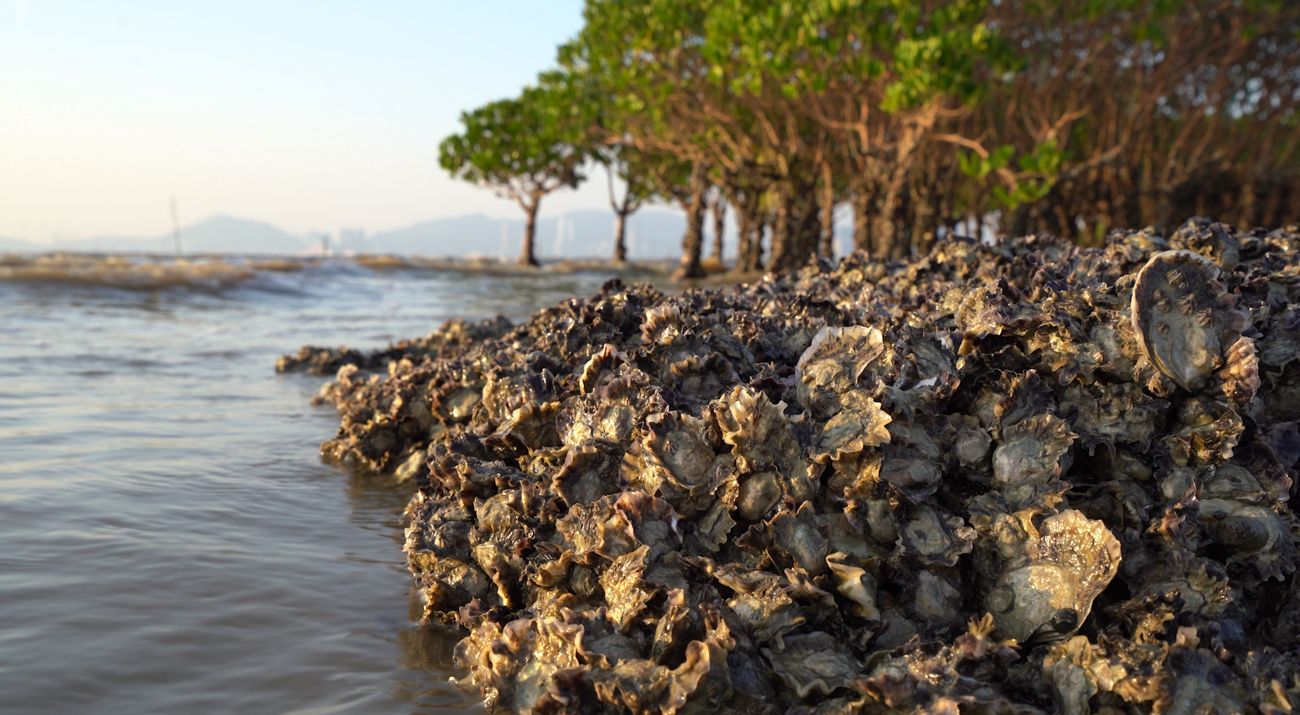
Oyster Reefs

85% of Shellfish Reefs are Lost Globally,
Hong Kong is No Exception.
Despite Hong Kong’s rich marine biodiversity – home to over 5,900 species, or more than one-quarter of all marine species recorded in mainland China – marine conservation efforts have lagged far behind those on land. Only about 6% of Hong Kong’s marine waters are protected, well below the global target of 30%. Many ecologically important habitats, including oyster reefs, remain outside of protected areas and face persistent threats, particularly in western waters.
Oyster reefs and other shellfish reefs deliver vital benefits to people and the planet, including providing habitat for marine life, supporting fish production, regulating water quality and protecting coastalines. Yet, over the past two centuries, more than 85% of the world’s shellfish ecosystems have been lost. Hong Kong is no exception. Historical dredging, reclamation, and urban development have decimated once-abundant oyster habitats across the territory. Today, any remaining oyster reefs are not officially recognised as ecologically important, are unprotected and therefore highly vulnerable to ongoing harvesting, degradation and reclamation projects, including the proposed Kau Yi Chau Artificial Islands, which do not take shellfish reefs into account when conducting the Environmental Impact Assessment.
Often overlooked, the humble oyster is the unsung hero of our seas.
Starting life as microscopic free-floating larvae, young oysters will settle on hard surfaces – preferably the shells of adult oysters – to complete their development. Over time, as more larvae settle and grow, the oysters build large, dense colonies on top of each other known as oyster reefs. Click the box below to learn about the important role of oyster reefs:

Filter Water
Oyster reefs provide a multitude of benefits to nature and people. Just one oyster can filter 200 litres of water a day, helping improve water quality in our oceans.

Promote Biodiversity
Oyster reefs provide habitat and nursery grounds for many native species that are otherwise lost from our shores.
Fish, crabs and other marine species find food, shelter and breeding grounds among the shells, with one study in Hong Kong finding six times more biodiversity on oyster reefs than on mudflats.

Increase Fish Stocks
Oysters, mussels and clams all suck in seawater, filtering out edible algae and nutrients and depositing what they can’t eat on the seafloor. This provides food for invertebrates, like worms and crabs, that then help feed fish.

Stabilize Shorelines
Oyster reefs can buffer strong waves and reduce erosion, which makes the coast more stable and supports the growth of seagrass beds.

Hong Kong’s Cultural Heritage
Hong Kong has a long history culturing and harvesting oysters (at least 700 years). Traditional methods of oyster cultivation (bottom cultivation) designated as Hong Kong’s Intangible Cultural Heritage.
Beyond savoring oysters, the harvesting of oysters for lime production, a practice that started over 1000 years ago. By the early 1900s, the Pearl River Delta was producing thousands of tons of lime annually, with significant contributions from Macau to Jiangmen. In Hong Kong, records show a substantial workforce and fleet dedicated to shell extraction, supporting regional economies such as salt production and construction.
The Nature Conservancy (TNC) is working to restore oyster reefs in Hong Kong and advocate for better protection of these precious ecosystems.
Hong Kong's Biodiversity Strategy and Action Plan (BSAP) lays out Hong Kong's biodiversity strategy over the next 10 years. The public had a once-in-a-decade opportunity to advocate for stronger marine conservation policies and the health of Hong Kong waters by submitted their views before July 11, 2025. TNC has submitted formal recommendations to AFCD.
TNC’s Key Recommendations for the BSAP
To reverse biodiversity loss and strengthen coastal resilience, TNC recommends that the updated BSAP prioritize the following:
- Expand Marine Protected Areas (MPAs) to Safeguard Coastal Ecosystems
- Scale up protection in line with the global “30x30” target by designating new MPAs and implementing other effective area-based conservation measures (OECMs).
- Prioritize the inclusion of biodiversity hotspots and underrepresented habitat types, notably areas such as South Lantau, Tung Chung, Port Shelter, and the coastal area of Deep Bay.
- Initiate Large-Scale Restoration of Degraded Oyster Ecosystems to reverse biodiversity loss and improve water quality
The 2030 Global Biodiversity Framework recognizes that conservation alone is not enough—restoration must be scaled up to reverse biodiversity loss. TNC and the University of Hong Kong have conducted territory-wide feasibility assessments, showing that oyster reef restoration is both scientifically sound and technically feasible. The key barrier is access to suitable seabed areas. To restore these vital ecosystems, we should:- Include targeted restoration strategies in marine park management plans.
- Make seabed areas available for restoration efforts outside of protected areas.
- Launch reef restoration projects in at least 30% of suitable bays by 2030, to enhance biodiversity, improve water quality, and rebuild ecosystem resilience.
- Strengthen Legal Protection for Endangered Species and Ecosystems
- Establish and maintain an up-to-date list of locally threatened species and ecosystems to inform conservation priorities.
To support this, TNC—together with the University of Hong Kong—is currently conducting an IUCN Red List of Ecosystems assessment for Hong Kong’s oyster reefs, providing the scientific foundation needed to formally recognize and protect these endangered habitats. - Update and amend legislation to formalize the list and extend legal protection to currently unprotected but endangered species—including oysters and key marine fishes.
- Develop species-specific action plans to recover endangered ecosystems such as oyster reefs, through expanded protected areas and scaled restoration.
- Establish and maintain an up-to-date list of locally threatened species and ecosystems to inform conservation priorities.
A Milestone for Biodiversity in Hong Kong -- and a Strong Foundation for Future Collaboration
On 31 December 2025, the Environment and Ecology Bureau released the Hong Kong Biodiversity Strategy and Action Plan (BSAP) 2035, setting a ten-year vision for a more resilient, nature-positive Hong Kong. The Nature Conservancy welcomes this important step forward and is pleased to see several key recommendations we and our partners advocated for now reflected in the final plan.
Highlights include:
- Nature-based Solutions (NbS) are embedded as a central pillar in the BSAP, TNC, alongside partners like Civic Exchange, has been instrumental in mainstreaming NbS and will continue advancing this work.
- Oyster reefs are now formally recognized as a habitat for restoration – a major step forward that enables scaling up efforts, driven by strong community engagement and public advocacy.
- The Coastal Protection Park (CPP) has been reaffirmed and aligns with TNC’s long-term, community-led efforts along Hong Kong’s coast. We’re ready to contribute through inclusive management and conservation finance.
- Wetland revitalisation and conservation finance are recognized as key action areas – opening the door for us to apply global expertise to local solutions.
The BSAP 2035 represents a strong alignment with TNC’s ongoing work — from marine and wetland restoration to youth engagement and nature-positive urban planning. It signals a growing commitment to whole-of-society collaboration for a more resilient, nature-positive future.
We are excited to support the implementation of the BSAP 2035 and to contribute our expertise in habitat restoration, policy engagement, and innovative conservation finance. This milestone reflects the collective efforts of many, and we look forward to working closely with our supporters, partners, policy engagement, and communities to turn this strategy into impactful action.
Read the full BSAP here: HKBSAP_2035_EN.pdf

City of Shells: Our Forgotten Oyster Reefs
To learn more about oyster reefs and why they matter to Hong Kong, please watch this TNC featured documentary which explores the ecological, cultural, and historical significance of these lost ecosystems – and the opportunity to restore them.
Read More

Hong Kong Oyster Restoration
TNC restores oyster reefs in Hong Kong to improve water quality, increase local fish production, and educate the public about the importance of these marine habitats.

Scaling Up Community Conservation for Deep Bay
Protect sensitive biodiversity along the coast and formulate long-term policy recommendations for the proposed Coastal Protection Park

Recycling oyster shells from restaurants to benefit nature
Get to understand TNC “Save Our Shells” Initiative

